Showing posts with label social exp. Show all posts

Monday, 8 June 2015

The Obsession behind the BEHIND ;)


What’s driving the current global obsession with Booty,Arsenal ,Ikebe, bakassi,butt, नितंब, culo, matako, طيز , patootie, 屁股 and whoopee cakes?… These news flashes and more in this week’s Sex in the Press.


In recent years, booty – a strongly-curved bum – has bounced far beyond its traditional strongholds of hip-hop videos and communities in Africa and Latin America.

'Butts' have taken over 'breasts' as common search term. Butt implants are currently the mostly quickly growing form of plastic surgery worldwide. International fashion designers are developing bum-enhancing jeans. Electronic music companies now sell devices that can sample twerking – the shaking of a strongly-curved bums – and turn these movements into beats, to inspire more twerking. 

Is this a sign of globalisation? Or is the world becoming less divided into penises and vaginas, and instead, more united by what we all have: a sitting cushion

The Dog Effect???

Perhaps an answer lies with the question: ‘Why do dogs like to smell butts so much?’.

A dog smells another dog’s butt to get the gossip on another dog’s mood, eating patterns and love life. It’s basically social media but then via chemicals instead of news feeds. And chemical communication is found throughout the animal kingdom – including with humans.

So is the ass just trying to tell us something?
Unfortunately, humans lack a couple of things that dogs have: chemical-secreting anal sacs and a secondary olfactory system that is able to bypass the smell of poop.
So we must sniff deeper for an explanation behind the trending of culo.

BUTT FOR BRAINS
“Researchers have discovered that the development of babies' brains depends on fat supplies that are located in their moms' posteriors and thighs, and the amount stored there might directly impact a kid's intelligence, according to ‘Curvy women can make smarter kids, study suggests’.

So perhaps “men might be attracted to curvier women because there's a chance of them having smarter kids,” a reproductive scientist suggests.

A previous study found that when men are hungry, they show a slight preference for larger women – perhaps because it suggests that such women have better access to food. Another study found that admiring a curvy women triggers the part of the brain associated with drugs and alcohol.

So is our thirst for ikebe simply a hard-wired addiction?

A BUBBLE OF EVOLUTION?

“The reason we're so attracted to serious curves goes all the way back to our hunter-gatherer ancestors. You see, a woman having a back that curves approximately 45 degrees above the top of her butt means she would have had an evolutionary advantage in pre-civilized society,” according to Turkish researchers who suggest that a big butt helps pregnant women maintain a better centre of gravity. They are then able to forage longer into pregnancy without risking spinal injury.

An appealing idea. But like many appealing ideas pitched in the name of evolutionary biology: bullsh*t. We simply don’t know enough about our ancestors to make such conclusions. As one sceptical scientist points out: increased foraging could also increase one’s chance at being eaten by a sabre-toothed tiger.

What ever the case, am of the opinion that humans will still move to another next big thing in vogue....Just waiting ;)


Original author: https://lovematters.co.ke/news/bums-booty-and-passion-ass


Kidnapping of Chimamanda Adichie's Father


"MY father was kidnapped in Nigeria on a Saturday morning in early May. My brother called to tell me, and suddenly there was not enough breathable air in the world. My father is 83 years old. A small, calm, contented man, with a quietly mischievous humor and a luminous faith in God, his beautiful dark skin unlined, his hair in sparse silvery tufts, his life shaped by that stoic, dignified responsibility of being an Igbo first son.

He got his doctoral degree at Berkeley in the 1960s, on a scholarship from the United States Agency for International Development; became Nigeria’s first professor of statistics; raised six children and many relatives; and taught at the University of Nigeria for 50 years. Now he makes fun of himself, at how slowly he climbs the stairs, how he forgets his cellphone. He talks often of his childhood, endearing and rambling stories, his words tender with wisdom.

Sometimes I record his Igbo proverbs, his turns of phrase. A disciplined diabetic, he takes daily walks and is to be found, after each meal, meticulously recording his carbohydrate grams in a notebook. He spends hours bent over Sudoku. He swallows a handful of pills everyday. His is a generation at dusk.

On the morning he was kidnapped, he had a bag of okpa, apples and bottled water that my mother had packed for him. He was in the back seat of his car, his driver at the wheel, on a lonely stretch between Nsukka, the university town where he lives, and Abba, our ancestral hometown. He was going to attend a traditional meeting of men from his age group. A two-hour drive. My mother was planning their late lunch upon his return: pounded yam and a fresh soup. They always called each other when either traveled alone. This time, he didn’t call. She called him and his phone was switched off. They never switched off their phones. Hour after hour, she called and it remained off. Later, her phone rang, and although it was my father’s number calling, a stranger said, “We have your husband.”

Kidnappings are not uncommon in southeastern Nigeria and, unlike similar incidents in the Niger Delta, where foreigners are targeted, here it is wealthy or prominent local residents. Still, the number of abductions has declined in the past few years, which perhaps is why my reaction, in the aftermath of my shock, was surprise.

My close-knit family banded together more tightly and held vigil by our phones. The kidnappers said they would call back, but they did not. We waited. The desire to urge time forward numbed and ate my soul. My mother took her phone with her everywhere, and she heard it ringing when it wasn’t. The waiting was unbearable. I imagined my father in a diabetic coma. I imagined his octogenarian heart collapsing.

“How can they do this violence to a man who would not kill an ant?” my mother lamented. My sister said, “Daddy will be fine because he is a righteous man.” Ordinarily, I would never use “righteous” in a non-pejorative way. But something shifted in my perception of language. The veneer of irony fell away. It felt true. Later, I repeated it to myself. My father would be fine because he was a “righteous man.”

I understood then the hush that surrounds kidnappings in Nigeria, why families often said little even after it was over. We felt paranoid. We did not know if going public would jeopardize my father’s life, if the neighbors were complicit, if another member of the family might be kidnapped as well.

“Is my husband alive?” my mother asked, when the kidnappers finally called back, and her voice broke. “Shut up!” the male voice said. My mother called him “my son.” Sometimes, she said “sir.” Anything not to antagonize him while she begged and pleaded, about my father being ill, about the ransom being too high. How do you bargain for the life of your husband? How do you speak of your life partner in the deadened tone of a business transaction?

“If you don’t give us what we want, you will never see his dead body,” the voice said.
My paternal grandfather died in a refugee camp during the Nigeria-Biafra war and his anonymous death, his unknown grave, has haunted my father’s life. Those words — “You will never see his dead body” — shook us all.

Kidnapping’s ugly psychological melodrama works because it trades on the most precious of human emotions: love. They put my father on the phone, and his voice was a low shadow of itself. “Give them what they want,” he said. “I will not survive if I stay here longer.” My stoic father. It had been three days but it felt like weeks.

Friends called to ask for bank-account details so they could donate toward the ransom. It felt surreal. Did it ever feel real to anybody in such a situation, I wondered? The scramble to raise the money in one day. The menacingly heavy bag of cash. My brother dropping it off, through a circuitous route, in a wooded area.

Late that night, my father was taken to a clearing and set free.
While his blood sugar and pressure were checked, my father kept reassuring us that he was fine, thanking us over and over for doing all we could. This is what he knows how to be — the protector, the father — and he slipped into his role almost as a defense. But there were cracks in his spirit. A drag in his gait. A bruise on his back.
“They asked me to climb into the boot of their car,” he said. “I was going to do so, but one of them picked me up and threw me inside. Threw. The boot was full of things and I hit my head on something. They drove fast. The road was very bumpy.”

I imagined this grace-filled man crumpled inside the rear of a rusty car. My rage overwhelmed my relief — that he suffered such an indignity to his body and mind.
And yet he engaged them in conversation. “I tried to reach their human side,” he said. “I told them I was worried about my wife.”
The next day, my parents were on a flight to the United States, away from the tainted blur that Nigeria had become.

With my father’s release, we all cried, as though it was over. But one thing had ended and another begun. I constantly straddled panic; I was sleepless, unfocused, jumpy, fearful that something else had gone wrong. And there was my own sad guilt: He was targeted because of me. “Ask your daughter the writer to bring the money,” the kidnappers told him, because to appear in newspapers in Nigeria, to be known, is to be assumed wealthy. The image of my father shut away in the rough darkness of a car boot haunted me. Who had done this? I needed to know.

But ours was a dance of disappointment with the authorities. We had reported the kidnapping immediately, and the first shock soon followed: Security officials in my home state asked us to pay for anti-kidnap tracking equipment, a large amount, enough to rent a two-bedroom flat in Lagos for a year. This, despite my being privileged enough to get personal reassurances from officials at the highest levels.

How, I wondered, did other families in similar situations cope? Federal authorities told us they needed authorization from the capital, Abuja, which was our responsibility to get. We made endless phone calls, helpless and frustrated. It was as though with my father’s ransomed release, the crime itself had disappeared. To encounter that underbelly, to discover the hollowness beneath government proclamations of security, was jarring.

Now my father smiles and jokes, even of the kidnapping. But he jerks awake from his naps at the sound of a blender or a lawn mower, his eyes darting about. He recounts, in the middle of a meal, apropos of nothing, a detail about the mosquito-filled room where he was kept or the rough feel of the blindfold around his eyes. My greatest sadness is that he will never forget"

Tuesday, 12 May 2015

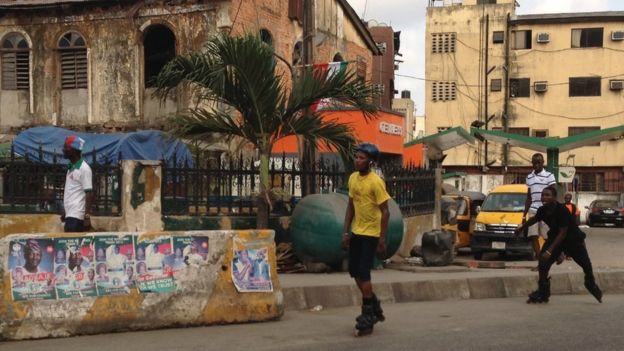
New and Improved Lagos!

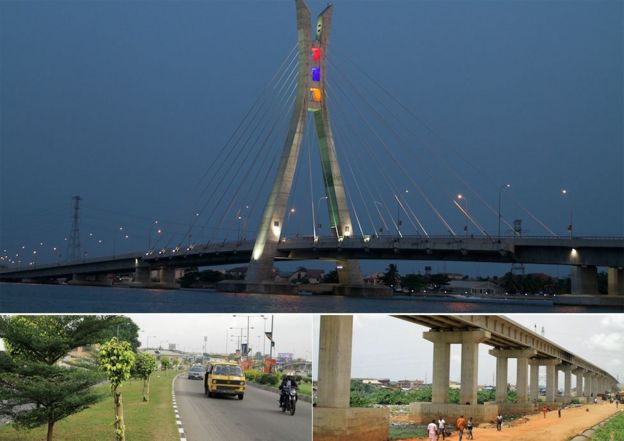
Under the government of Gov. Babatunde Fashola, Lagos has changed a whole lot, i didn't get to experience the harsh side owing to the fact that i just moved to Lagos almost a year ago,but back then we would hear stories of the almighty Lagos o ;). So it's with great joy i present to everyone the new LASGIDI!!


Revamping the transport system has been the focus of bringing an element of order to the chaotic city, and much of the credit lies with outgoing Lagos governor Babatunde Fashola.


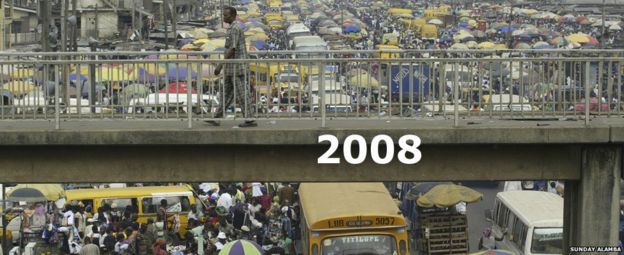
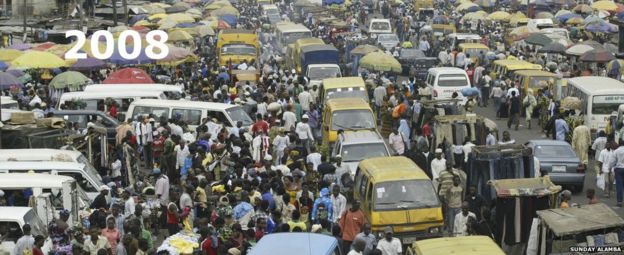
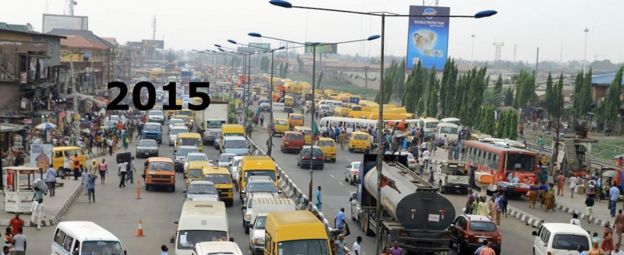
These photos of Oshodi market show how the gridlocked traffic has been eased over the last seven years. Environment ministry officers showed no mercy...


They demolished all the illegal structures in just a few days in 2009. Roads have since been rebuilt and separate sections allocated for buses collecting passengers.


Providing fast lanes for buses has also been a priority, as crossing the city in rush hour can take three hours. Red buses, part of the Bus Rapid Transport (BRT), are now more common...


However, commuters are sometimes left stranded by nationwide fuel shortages. The new routes and bus stations are expected to have digital displays with up-to-date travel information.

With a population of 21m and growing, the vision is to have seven overground railway links. The first of these - the Blue Line - is expected to open this year...

But the project, which has sections of the track raised above ground, has been hit by financial problems and disputes with the federal government - as the state has been run by a rival party.

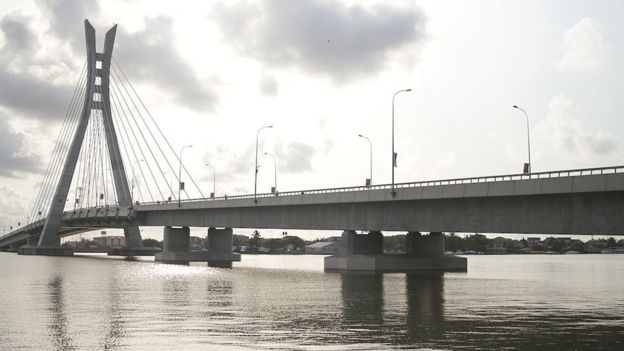
It is a brave cyclist who takes to the roads as dangerous driving in the city is often to blame for accidents and hold ups. This is the toll on the Lekki-Ikoyi bridge, which opened in 2013...

It links the booming suburb of Lekki with affluent Ikoyi but there have been disputes over the 250 naira ($1.25, £0.85) toll. Some residents feel the publicly funded bridge should be free.

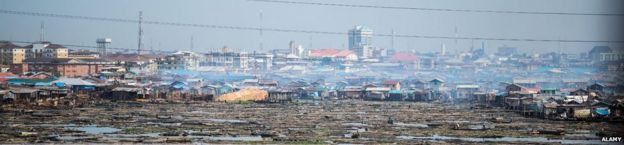
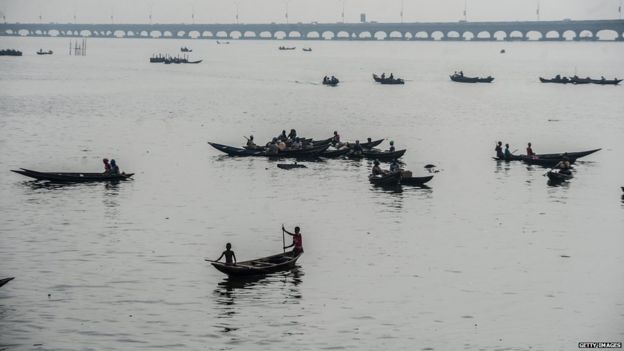
Three bridges link the mainland to Lagos Island, the heart of the city. Makoko lagoon slum can be seen from Third Mainland Bridge. In recent years, some slums have been demolished...


But no provision is being made for new housing for the poor. This is the Eko Atlantic City project.

It is being built on reclaimed land and developers hope it will become the financial centre of Nigeria - and home to at least 400,000 residents.


The state government is building some housing and has launched a mortgage scheme aimed at the middle class. This estate will be made up of two- and three-bedroom apartments.

Part of the Lagos facelift has focused on removing rubbish from underneath flyovers and bridges and the gangs, known as "areas boys", who used to hang around there.


Lagos produces 12,000 tonnes of waste a day. Households pay for rubbish collections. One scheme is trying to encourage recycling by awarding points that can be exchanged for prizes.

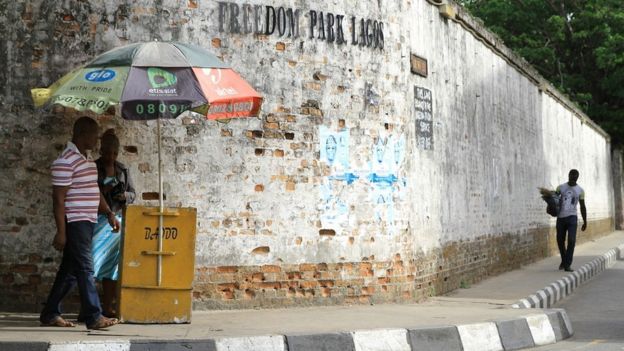
A former colonial prison on Lagos Island has been turned into a leisure and arts centre. With many live performances at Freedom Park Lagos, it has become the cultural hub of the city.

But there are fears some of Lagos' old architecture - like the Brazilian quarter of Lagos Island - will be lost, as demolition is often preferred to make way for new buildings and shopping malls.


original work by: Ayo Bello

Newly Married:Reality Vs Expectation:

This Is The Reality Of Most Couples’ Wedding Night...Enjoy :)
Expectation: Crossing the threshold like in the movies.


Reality: Drunkenly forgetting any traditions and stumbling through the doors in a post-wedding daze.


Expectation: First magical conversation alone in the room.


Reality: Slurring mess about either love or hunger from not eating — impossible to tell which.


This is when 40% of couples will pass out.


Expectation: Making love immediately.


Reality: Ordering pizza immediately.


Expectation: Getting undressed.


Reality: The event of getting undressed.


Expectation: Consummating with ease.


Reality: Powering through drunkenness and pizza bloat to make it happen.


Must....Consummate. ....Marriage.
This is when the remaining 50% of couples will give up and pass out.


Expectation: Orgasming (only 10% of couples will make it this far).


Reality: Orgasming with some extra effort.


Expectation: Falling asleep in each other’s arms after one of the best days of your life.


Reality: Drunkenly passing out in each other’s arms after one of the best days of your life.

originally from Loryn Brantz 

Friday, 24 April 2015

Awesome Shoes For Impoverished Kids That Grow With The Children

If you’ve ever had kids or even remember what it was like to be a kid, you probably know just how fast kids grow out of their clothes and shoes. Kenton Lee recognized this problem when he set out to make inexpensive shoes for children living in poverty around the world. His solution?
Make shoes that grow with the children.

Lee started an organized called The Shoe That Grows to help kids living in poverty never have to worry about not having shoes again. Some 300 million kids walk through their young lives completely barefoot because shoes are too expensive for families to buy for their kids. They don’t have the financial means and the kids grow out of them so fast anyway.

Lee’s shoe design is one that grows and expands and, unlike other inexpensive shoe options, are incredibly durable. 


The shoe grows and expands in three primary places to allow for maximum use for the growing young person.


Thursday, 23 April 2015

20 Signs You Have Found Your Soul Mate


Finding a soul mate is #1 for many people. Personally, I believe you have a lot of chances to do so. Your soul mate might not necessarily just be one person. There’s a reincarnation based believe that I’ve always been fond of. That belief is that when you die, your soul shatters and breaks into pieces. Those pieces are randomly brought together with pieces of many other souls to form new souls and new people. So when you meet someone that you so strongly click with or find that person who is so clearly your soul mate, you’re really finding pieces of your soul in them, and they’re finding pieces of their soul in you.


Neat huh? No matter how it happens, these are 20 signs you’ve found your soul mate.
  1. Your soul mate is endlessly loyal to you.
  2. Your soul mate is always supportive of you.
  3. Your soul mate has a similar guiding compass.
  4. Your soul mate sparks an intense passion in you.
  5. You can communicate comfortably with your soul mate.
  6. Your soul mate makes you feel special.
  7. Your soulmate transcends spiritual boundaries with you.
  8. Your soul mate appreciates your affection.
  9. Your soul mate thinks you’re just irresistible.
  10. Your soul mate helps you feel safe.
  11. You feel like you can completely trust your soul mate.
  12. You don’t just experience their endless love, you feel it.
  13. You’re spiritually connected more so to your soul mate than anyone else.
  14. You can spend time sitting in silence but know what your soul mate is thinking.
  15. Even in times of tragedy, you find strength in your soul mate.
  16. Your soul mate turns to you with all their secrets, hopes and dreams.
  17. Your soul mate has the same ideas about raising children as you.
  18. Your soul mate always includes you in major and minor life decisions.
  19. Your soul mate pushes you to be better and you return that favor.
  20. As people, in terms of being happy and successful, you and your soul mate thrive together
So, now you know...go out there and find the person :)

Sunday, 19 April 2015

Lagos To Abuja Victory Trek


Suleman Hasheem, the man on foot trek from Lagos to Abuja as part of his pledge to celebrate the victory of Gen. Muhammadu Buhari in the last presidential election yesterday arrived Suleja, a suburb just 35 kilometers away from the nation’s capital.

Hasheem who has now trekked for 18 days arrived Suleja at about 1:37pm to a rousing welcome by supporters and was received at the palace of the emir of Suleja, HRH Awwal Ibrahim.

The 33 year-old, had made a promise to trek from Lagos to Abuja if Buhari wins the presidential election, saying the purpose of terminating his journey in Abuja is where he thinks he could see the retired General and congratulate him.

Hasheem, who grew up in Osun and Lagos, now lives in Ibadan where he is working in a construction company.

Hasheem told reporters that his decision to embark on the mission was borne out of the happiness he feels for Buhari for becoming a leader for the masses.

He said in Bida four days ago that after 13 days of trekking, he worn-out five pairs of shoes with a new pair just bought for him by a good Samaritan.

Hasheem said before embarking on his mission, he ensured that he was financially equipped but to his amazement, up to the time he arrived Suleja, he did not have to spend a single kobo from his pocket because of kind, generous receptions he has been receiving.

Monday, 6 April 2015

Fayrouz L’Original Expression Show – Season 2


Last year, the Fayrouz L’Original Show kicked off with a call to entry where fashion designers, models, photographer and make-up artists from all over the country created a team of four and took on a series of tasks. The show ended with an amazing grand finale event and the winning team, Elan walked away with $20,000 prize.

Season 2 is back and Fayrouz is on the hunt for the next original team, have you got what it takes? Create a team of four – model, fashion designer, photographer and make-up artist and you could win 4M Naira in the Fayrouz L’Original Expression Show. Go to http://fayrouzloriginal.com/competition/ to register!

Wednesday, 1 April 2015

10 smartest people in the world

The Human brain is at the epicenter of the human nervous system enclosed in a hard shell called cranium, one of the most vital part of our system. 
The Human brain is three times as large as the brain of any other mammal with an equivalent body size.
Few people born gifted by the most precious wealth of the nature, intelligence.
They are different from ordinary people and their approach toward different situations of life is unique.
They belong to different walks of life and do better than the average person.
Most of the intelligent people struggle very hard throughout their lives and made a history with their innovative skills and accomplishments.
This list honors the Top 10 Smartest People in the World.
10.Stephen Hawking 
Stephen Hawking was born 300 years after the death of Galileo in England. At the age of eleven, Stephen went to St. Albans School and then on to University College, Oxford. Stephen wanted to study Mathematics. Mathematics was not available at University College, so he pursued Physics instead. After 3 years, he was awarded a first class honours degree in Natural Science. Stephen then went on to Cambridge to do research in Cosmology, there being no one working in that area in Oxford at the time. His supervisor was Denis Sciama, although he had hoped to get Fred Hoyle who was working in Cambridge. After gaining his Ph.D. he became first a Research Fellow and later on a Professorial Fellow at Gonville and Caius College. He has an IQ of 160. He has twelve honorary degrees. He was also awarded the CBE in 1982, and was made a Companion of Honour in 1989. He is the recipient of many awards, medals and prizes, is a Fellow of The Royal Society, and a Member of the US National Academy of Sciences.
9. Paul Gardner 
Allen Paul Gardner Allen is one of the founder of Microsoft. He also happens to have an IQ level of 170. As on 2013, Allen is the 53rd richest person in the world. He is well known all across the world and is recognized as an inventor, investor, and a philanthropist of the 20th and 21st century. In 2010, he became a signatory of The Giving Pledge, promising to give at least half of his fortune to philanthropic causes


8. Sir Andrew Wiles


Sir Andrew Wiles made significant contribution to mathematics when he proved Fermat’s Last Theorem which is the most difficult problem in maths. With an IQ of 170, he is also a Royal Society Research Professor at Oxford Society and specializes in number theory. He has also received 15 prizes in Math and Science.


7. Judit Polgar


She is a child prodigy with an IQ of 170 and has already taken over Bobby Fischer’s record in chess. She is touted as the most talented female chess player of all times. Polgár is the only woman to have won a game from a current world number one player, and has defeated nine current or former world champions in either rapid or classical chess: Anatoli Karpov, Garry Kasparov, Boris Spassky, Vasily Smyslov, Veselin Topalov, Viswanathan Anand, Ruslan Ponomariov, Alexander Khalifman, and Rustam Kasimdzhanov. She is the second chess master to appear on this list.


Apart from his okay acting skills, James Woodss has an IQ level of 180. The film, stage and TV actor went to UCLA for his high school and got a full scholarship at MIT. Woods was a vocal supporter of former U.S. President George W. Bush and the Iraq War, though he is a registered Democrat. He is also an avid support of former Mayor of New York Rudy Giuliani. Woods lobbied hard to play Giuliani in the biopic Rudy: The Rudy Giuliani Story, and considers the role one of the favorites of his career.

5. Garry Kasparov


He is Russia’s chess grandmaster who became the youngest undisputed world champion at the age of 22. He beat the then-champion Anatoly Karpov after a head-on battle in 1985. Kasparov held the official world title recognized by the international chess federation until 1993. A dispute occurred forcing Kasparov to give up the crown and to form instead another chess association called Professional Chess Association. In 1997, he lost a chess match to Deep Blue, the first time a world champion had lost to a computer under standard time controls. Kasparov was recognized as the “classical” world champion until 2000, when he was defeated by Vladimir Kramnik. He has an IQ of 190. In March 2005, Kasparov announced his retirement from professional chess, so that he could devote his time to politics and writing. He formed the United Civil Front movement, and joined as a member of The Other Russia, a coalition opposing the administration and policies of Vladimir Putin.

4. Rick Rosner


With an exceptional IQ of 192, Rick Rosner is a famous American TV writer, who happens to also be intelligent. Other thing that is fascinating about Rosner is his work experience which includes working as a stripper, bouncer, nude model, and a roller skating model. He now writes and produces for quiz shows and for several programs that are produced by Jimmy Kimmel, including The Man Show,Crank Yankers, and Jimmy Kimmel Live!

3. Ung-Yong


Even the term ‘child prodigy’ is an understatement for Ung-Yong. He displayed the signs of a future genius just when he was 6 months old. He could speak and read in Korean and other languages. His IQ score is 200.

2. Christopher Hirata


Hirata has an IQ of 225. At age 3, he entertained himself, at the grocery story, by calculating the total bill of items in his parent’s shopping cart, item-by-item, by weight,quantity, discounts, and sales tax At the age of 4, he became a part of Caltech. At just 12, he took up college level courses in physics and calculus and won a Gold Medal at International Physics Olympiad at 13 and became the youngest American to achieve that. He is currently teaching astrophysics at California Institute of Technology and he’s only 31 year’s old. Hirata deserves mention on this list for his achievement as the youngest American (at 13) to win a gold medal in the International Physics Olympiad in 1996.

1. Terence Tao


Tao has an amazing IQ of 250! His father once told the med that at the age of two, during a family gathering, his would teach a 5-year-old child arithmetic and English. At 9, he had reached college level and obtained a master’s degree at 16. He has won several awards and is the youngest professor at UCLA. He is also one of only two children (other than Lenhard Ng) in the history of the Johns Hopkins’ Study of Exceptional Talent program to have achieved a score of 700 or more on the SAT math section while just 8 years old. Tao had a score of 760. As of 2013 Tao has written over 250 research papers and 17 books.

CULLED from: naij.com